

How to Find Accurate Clothing Sizes Online
Table of Contents
- Why Clothing Sizes Vary So Much Between Brands
- How to Measure Your Body for Clothes Accurately
- How to Read Brand Size Charts and Conversion Tables
- Accounting for Fabric Stretch and Material Composition
- Tips for Buying Trendy Clothes Online with Confidence
- Common Mistakes to Avoid When Finding Your Size
- Finding Accurate Clothing Sizes Takes Practice
Last Updated: August 28, 2026
Finding accurate clothing sizes online is essential for anyone shopping for fashion. A size 8 in one brand fits completely differently than a size 8 in another, and returns due to poor fit waste time and money. This guide from Jessiz Boutique covers the exact steps to measure yourself, read size charts correctly, and make confident purchasing decisions when shopping for trendy clothes online.
Why Clothing Sizes Vary So Much Between Brands
Every retailer uses its own sizing standards. There's no universal regulation governing how a "medium" or "size 10" should fit. Vanity sizing compounds the problem, many manufacturers intentionally cut garments larger than the labeled size to make customers feel good about their size, making sizing completely unreliable across retailers.
Fabric composition directly impacts how garments fit. A cotton dress drapes differently than a polyester blend. A dress made from 95% cotton and 5% spandex will hug your body, while the same style cut from 100% linen will sit looser.
Manufacturing location matters too. A dress manufactured in Vietnam might fit differently than the same style produced in China or Portugal, even when sold under the same brand name.
How to Measure Your Body for Clothes Accurately
Accurate measurements are the foundation of finding the right size online. You can't rely on the size you wore last year or the size you wear at one store.
What You'll Need Before You Start
Gather these items before measuring:
- A flexible measuring tape (fabric tape measure, not a rigid ruler)
- A notepad or phone to record your measurements
- Fitted clothing or undergarments so the tape sits properly against your body
- A mirror to verify the tape is level and straight
- A second person to help (optional but helpful for accuracy)
Taking Bust, Waist, and Hip Measurements
These three measurements form the core of most size chart comparisons.
Bust measurement: Stand straight and relaxed. Wrap the tape measure around the fullest part of your chest, keeping it parallel to the ground. The tape should be snug but not tight enough to compress your chest. Record this number to the nearest half-inch.
Waist measurement: Measure around your natural waist, which is typically the narrowest part of your torso. Keep the tape at the same level all the way around. Don't suck in your stomach. Your waist measurement often determines whether you'll fit into a garment, especially for dresses and fitted tops.
Hip measurement: Measure around the fullest part of your hips and buttocks. Keep the tape parallel to the ground. This measurement is crucial for pants, skirts, and dresses that need to fit through the hip area.
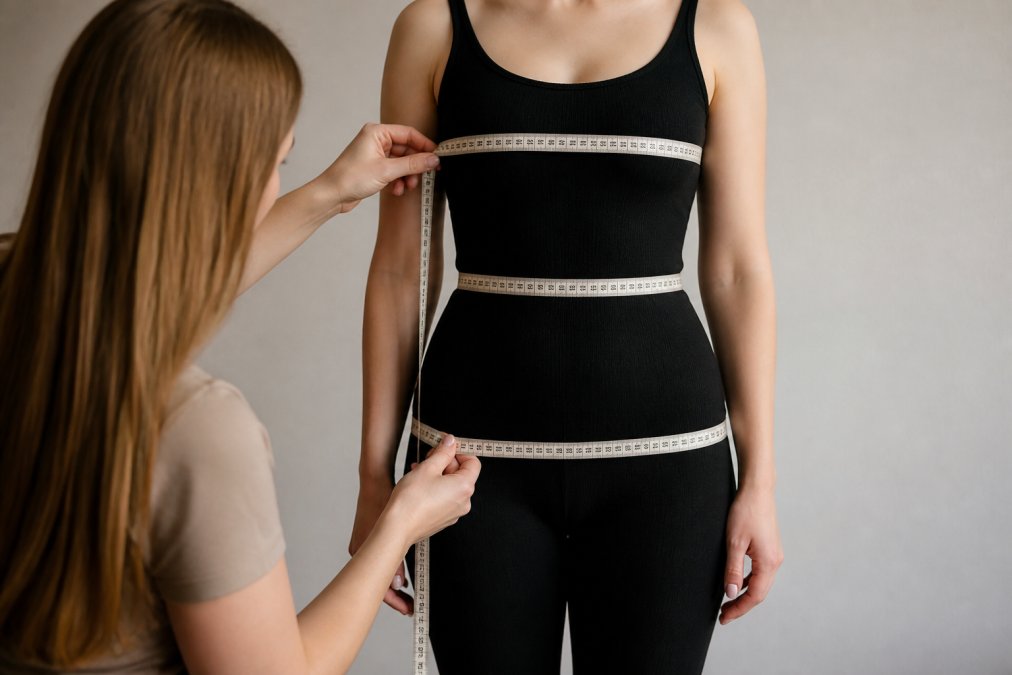
Write down all three measurements immediately. Most size charts use these three dimensions to determine your size.
Measuring Inseam and Length
Inseam measurement determines whether pants will fit without needing hemming. Stand straight and measure from your inner thigh down to your ankle, keeping the tape along the inside of your leg.
For dresses and tops, measure the length from your shoulder to where you want the garment to end. Shoulder-to-bust, shoulder-to-waist, and shoulder-to-hip measurements help you understand how long a dress will actually be on your body.
How to Read Brand Size Charts and Conversion Tables
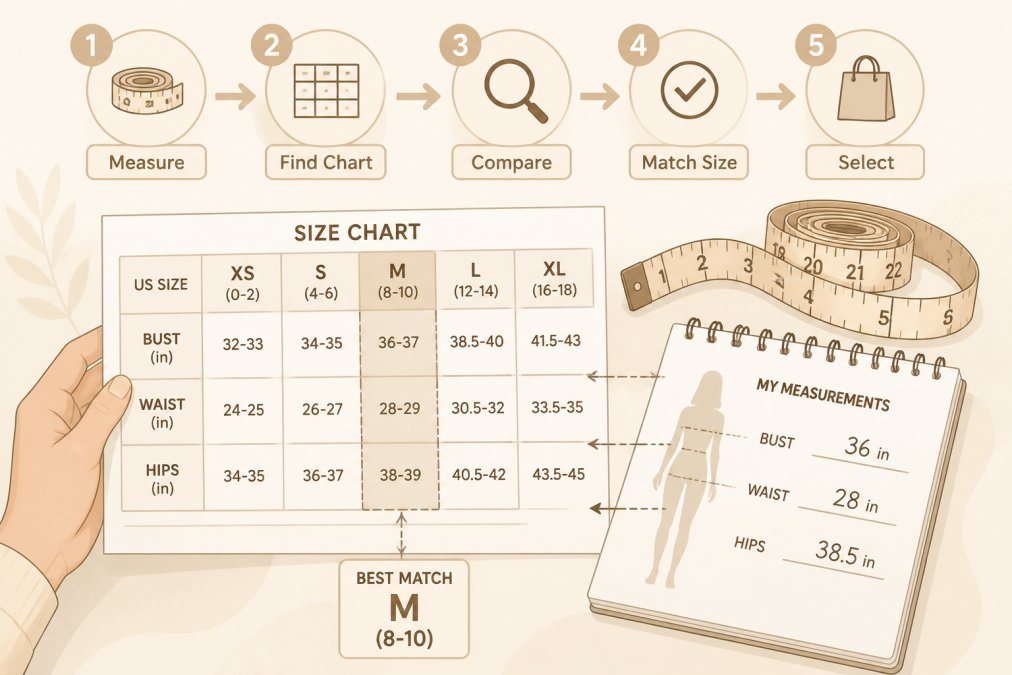
Size charts are the bridge between your body measurements and the garment you're ordering. A typical size chart lists sizes across the top row and measurements down the left column. Find your bust measurement in the chart, then check the corresponding size. Repeat for waist and hip. If your bust falls in a size 6 but your hip falls in a size 8, you need to decide whether the garment will fit better in the larger size.
Some brands provide size charts in inches, others in centimeters. Make sure you're comparing your measurements in the same unit. Multiply inches by 2.54 to get centimeters if needed (nist.gov).
Many retailers have multiple manufacturers, and different factories use different patterns. A dress from Brand X made in Vietnam might be cut smaller than a shirt from Brand X made in China. Check the product page for the specific manufacturer, then verify the size chart applies to that specific item.
Understanding International Sizing Standards
US sizing typically uses even numbers (0, 2, 4, 6, 8, 10, 12) for women's clothing.
European sizing uses a different scale entirely. A European size 36 roughly corresponds to a US size 4, while a European size 42 is closer to a US size 10 (iso.org).
UK sizing is similar to US sizing but runs smaller. A UK size 8 is approximately a US size 4 (iso.org).
Australian sizing generally aligns with US sizing but can vary by brand.
When shopping from international retailers, look for a size conversion chart on their website. Always check the conversion table and then verify against the product's specific size chart.
Comparing Your Measurements Against the Chart
Match your three primary measurements (bust, waist, hip) against the size chart. Most of the time, one measurement will suggest a smaller size while another suggests a larger size. Prioritize bust and hip fit, as these are harder to alter than length.
Pay attention to the measurement range for each size. If your bust measures 34.5 inches and falls between two sizes, check customer reviews to see whether that specific style runs small or large. If reviews mention the garment runs tight, size up. If reviews mention it's loose, you might fit the smaller size.
Accounting for Fabric Stretch and Material Composition
The fabric determines how a garment will fit more than almost any other factor.
Cotton and linen are non-stretch fabrics. They provide little give and require an accurate size match.
Spandex and elastane blends provide stretch. A fabric that's 95% polyester and 5% spandex stretches significantly. You might be able to size down in these fabrics if the fit is otherwise correct.
Knit fabrics like jersey and interlock stretch more than woven fabrics. A knit dress might fit better in a smaller size than the size chart suggests.
Check the product description for fabric content. Use this information to adjust your size selection. If you typically wear a size 8 and you're ordering a dress in a stretchy knit, you might try a size 6. If you're ordering a dress in rigid linen, stick with your measured size.
Tips for Buying Trendy Clothes Online with Confidence
Finding accurate clothing sizes online becomes easier when you approach each purchase strategically. Start by building a personal sizing profile for brands you shop from regularly.
Reading Garment Fit Descriptions and Customer Reviews
Fit descriptions tell you how a garment is intended to sit on the body. "Fitted" means the garment hugs your curves. "Regular fit" means it follows your body shape without clinging. "Loose fit" or "relaxed fit" means the garment sits away from your body.
Customer reviews provide real-world feedback about whether a garment fits as the size chart suggests. Look for reviews that mention fit specifically. Phrases like "runs small," "runs large," or "true to size" tell you whether the actual fit matches the size chart. Pay special attention to reviews from customers who mention their own size and measurements.
Using Virtual Try-On Tools and AI Sizing Technology
Modern retailers increasingly offer virtual try-on tools and AI-powered sizing recommendations. These tools use your measurements and body shape to predict which size will fit best. Some retailers ask you to input your measurements, then show you how a garment would fit on your body shape.
Even with these tools, always cross-reference with the product's size chart and customer reviews.
Common Mistakes to Avoid When Finding Your Size
The biggest mistake is ordering your "usual size" without measuring. Your size changes over time, and different brands use different standards. Measure yourself before every major shopping trip.
Don't ignore the size chart because you're in a hurry. Taking two minutes to check the measurements against your body dimensions saves you the hassle of a return.
Avoid assuming all items in a brand are cut the same way. A dress from a brand might fit you in a size 6, but a top from the same brand could fit better in a size 8 due to different construction and fabric. Check each product's individual size chart.
Don't trust your eyes alone when looking at product photos. The size chart and customer reviews tell you more than the photos do.
Overlooking fabric content is a costly mistake. Buying a stretchy knit in the same size as a rigid cotton will result in two completely different fits.
Finding Accurate Clothing Sizes Takes Practice
Getting sizing right online is a skill that improves with experience. Each purchase teaches you something about how different brands, fabrics, and styles fit your body. Keep notes on what worked and what didn't.
The process becomes faster once you've established a sizing profile. You'll know that Brand A runs small in stretch fabrics but true to size in cotton. You'll remember that Brand B's dresses are cut longer than average.
At Jessiz Boutique, we're committed to providing detailed size charts, honest product descriptions, and customer reviews that help you make confident purchasing decisions. Our curated collection of trendy fashion pieces is designed to fit a range of body types, and we encourage customers to use our sizing resources to find their perfect fit.
Start with accurate measurements, consult the size chart, read customer reviews, and consider the fabric composition. These steps dramatically increase the likelihood that your online purchase will fit beautifully when it arrives.
Frequently Asked Questions
How do I get accurate measurements for clothes when shopping online?
Wear fitted clothing or undergarments, use a soft flexible tape measure, and measure in front of a mirror. Keep the tape snug but not tight around your bust, waist, and hips. Measure your inseam by standing barefoot and measuring from your inner thigh to your ankle. Write down all measurements and compare them directly against the brand's size chart before ordering. Remeasure every few months, as body measurements can shift.
Why do clothing sizes vary so much between different brands?
Manufacturers use different sizing standards, fit philosophies, and construction methods. Vanity sizing (making garments larger while keeping the label size the same) varies by brand and category. International brands may use different measurement systems. Even within one brand, different product lines can fit differently. This is why comparing your body measurements to each brand's specific size chart is more reliable than assuming your usual size will fit.
What should I do if my measurements fall between two sizes on a size chart?
Check the fit description and customer reviews to see how that brand's garments typically fit. If you're between sizes, choose the larger size if the fabric has no stretch, or if reviews mention the fit runs small. For stretchy fabrics like jersey or spandex blends, the smaller size may work. Read reviews from customers with similar body shapes to yours for the most reliable guidance on fit.
How can I reduce returns when buying trendy clothes online?
Always measure yourself and compare against the brand's size chart before ordering. Read customer reviews that mention fit, length, and how true-to-size the garment is. Check the fabric content and look for fit descriptions that note whether items run small, large, or true to size. Use virtual try-on tools if available. Request detailed product photos showing seams, hem length, and how the garment drapes on different body types.
Finding accurate clothing sizes online removes the guesswork from fashion shopping and makes online ordering enjoyable instead of stressful. Jessiz Boutique provides detailed size charts and customer reviews specifically designed to help you make informed sizing decisions. Shop with confidence knowing you've taken the steps necessary to find your perfect fit.
This article was written using GrandRanker