

How to Measure Body for Online Clothes
Table of Contents
- Why Accurate Body Measurements Matter for Online Shopping
- What You'll Need to Get Started
- How to Measure Bust, Waist, and Hips Correctly
- Essential Tips for Accurate Measurements
- Understanding Clothing Size Chart Interpretation
- Garment Ease, Fabric Stretch, and Body Type Variations
- Tips for Buying Trendy Clothes Online
- Common Mistakes to Avoid When Measuring
Last Updated: August 23, 2026
Why Accurate Body Measurements Matter for Online Shopping
Getting the right fit when you shop online starts with knowing your actual body dimensions. Online shopping removes the immediate feedback loop of trying something on in a store. A dress that looks perfect in the product photo might gap at the shoulders. Pants that seemed like the right length could puddle at your ankles. The disconnect between what you see on screen and what arrives at your door often comes down to guessing at your measurements instead of knowing them precisely.
When you understand how to measure body for online clothes accurately, you gain confidence in your purchases. You stop second-guessing whether a medium or large is right for you. You know exactly what your bust circumference is, where your natural waistline sits, and how your hip measurement compares to size charts. This guide walks you through the exact process of taking body measurements that work with online retailers' sizing systems.
What You'll Need to Get Started
Flexible measuring tape: A soft, flexible measuring tape (sometimes called a seamstress tape) conforms to your body's curves instead of creating gaps. These typically cost under $5 and come in standard lengths of 60 inches (the FTC). Avoid rigid rulers or hard measuring tapes meant for construction work.
Form-fitting clothing: Wear something snug enough to see your body's actual shape but not so tight it compresses your measurements. A fitted t-shirt and leggings work perfectly. Avoid loose sweatshirts or baggy jeans.
Full-length mirror: Position yourself in front of a mirror so you can see your posture and tape placement. This prevents standing in an unnatural position that throws off your measurements.
Flat surface for reference: Stand on level ground, not on soft carpet or uneven surfaces. This keeps your posture stable and your measurements consistent.
Notebook or phone notes app: Write down each measurement immediately after taking it.
How to Measure Bust, Waist, and Hips Correctly
These three measurements form the foundation of how to measure body for online clothes. Most size charts rely on these core dimensions because they define how garments will fit across your frame.
Measuring Your Bust Circumference
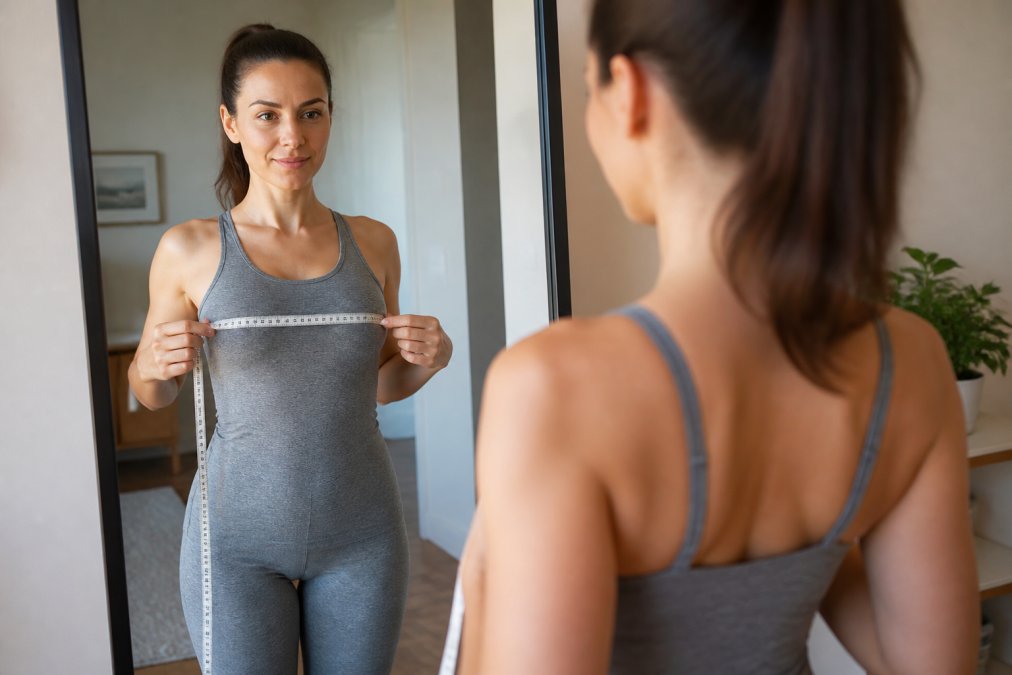
Your bust measurement is taken around the fullest part of your chest, typically at the level of your nipples.
Stand facing the mirror with your arms relaxed at your sides. Wrap the measuring tape around your chest horizontally, making sure it passes over the fullest part of your bust. The tape should be snug but not compressing your chest; you should be able to slip one finger under the tape comfortably. Keep the tape parallel to the floor.
Take the measurement at the end of a normal exhale, not while holding your breath. Read the number where the tape overlaps and write it down immediately. If you're between sizes (say, 34.5 inches), round to the nearest half-inch.
Finding Your Natural Waistline
Your natural waistline is the narrowest part of your torso, typically about an inch above your belly button (peer-reviewed research).
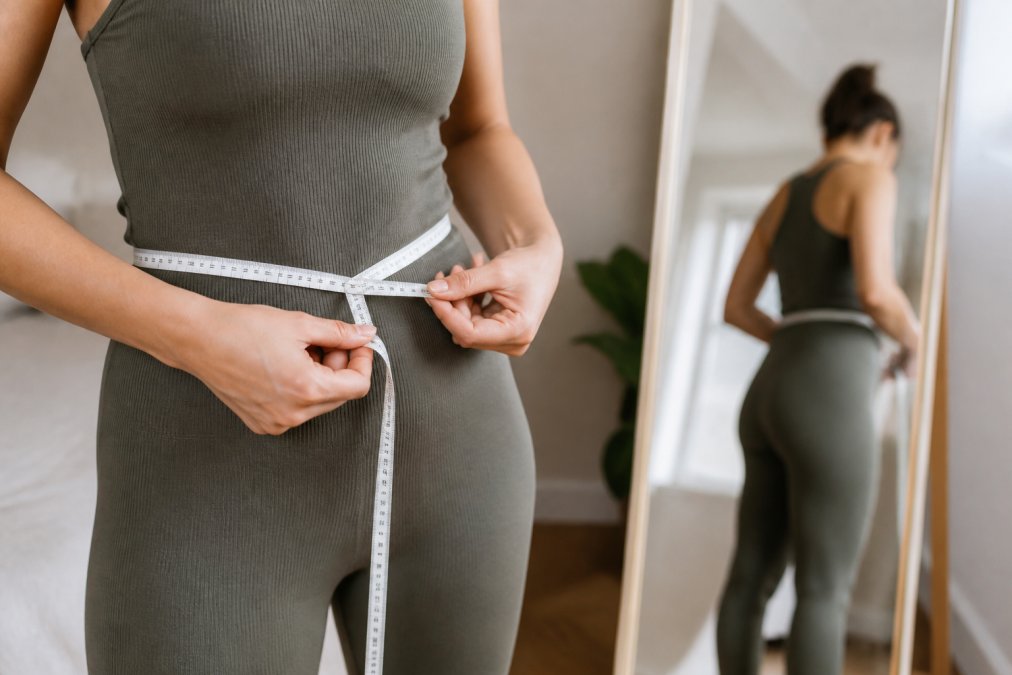
Stand sideways to the mirror so you can see the tape placement. Locate the narrowest part of your torso by running your hand down your side. Wrap the measuring tape around this point horizontally, keeping it parallel to the floor. The tape should sit comfortably without compressing your midsection. Keep one finger's worth of slack under the tape; pulling it tight creates a measurement that's smaller than your actual waist, which means clothes ordered to that size will be too tight.
Measuring Your Hip Circumference
Hip measurement is taken around the fullest part of your hips and buttocks, typically 7-9 inches below your natural waistline (peer-reviewed research).
Stand facing forward in the mirror. Wrap the measuring tape around the fullest part of your hips, keeping it parallel to the floor. The tape should feel comfortable, not tight or loose. Take your time finding the exact spot where the tape captures the maximum circumference. Write down this measurement and compare it to your bust and waist measurements.
Essential Tips for Accurate Measurements
Measure twice, record once: Take each measurement twice and verify you get the same number both times. If the second measurement differs by more than a quarter-inch, take it a third time.
Measure over form-fitting clothing, not bare skin: Measuring over a fitted shirt and leggings gives you numbers that better match how clothes will actually fit.
Keep your posture natural: Stand the way you normally do, not stretched tall or slouched.
Don't pull the tape tight: The tape should feel snug but comfortable. One finger under the tape is the standard.
Measure in the same location each time: If you're retaking measurements after a few weeks or months, measure in the same spot as before.
Record measurements to the nearest quarter-inch: Don't round to whole inches. Most online retailers' size charts use quarter-inch increments.
Understanding Clothing Size Chart Interpretation
Knowing your measurements means nothing if you can't read a size chart correctly. A typical size chart lists sizes across the top (XS, S, M, L, XL) and body measurements down the left side (bust, waist, hips). Your job is to find where your measurements fall and select the size that accommodates your largest dimension.
If your bust is 36 inches, your waist is 28 inches, and your hips are 38 inches, you don't average these numbers. You look at which size fits your largest measurement, in this case, the hips at 38 inches. This prevents the common problem of ordering a size that fits your waist but is too tight across the hips.
Some retailers provide garment measurements instead of body measurements. These show the actual dimensions of the finished piece, including seam allowance and intended ease. Always check the specific size chart for each retailer and product. A medium from one brand might fit completely differently from a medium from another brand.
Garment Ease, Fabric Stretch, and Body Type Variations
Your measurements are only half the equation. How a garment fits also depends on the designer's intended ease and the fabric's stretch properties.
Garment ease refers to the extra room built into a pattern beyond your actual body measurements. A fitted garment might have 1-2 inches of ease, while a loose, relaxed-fit garment might have 4-6 inches. Understanding ease prevents you from ordering a size that looks enormous on you.
Fabric stretch changes everything. A cotton t-shirt with no stretch requires precise measurements. A dress made from a fabric with 15% stretch might fit comfortably even if you're a quarter-inch off your measurement. Check the fabric content; if it's a blend with spandex, you have some forgiveness. If it's 100% cotton or linen, you need to be more precise.
Body type variations matter too. Someone with an athletic build might have measurements that don't follow the typical progression. Different body types fit into standardized size charts differently. When shopping at Jessiz Boutique, pay attention to product descriptions that mention fit details and stretch fabrics.
Tips for Buying Trendy Clothes Online
Compare multiple size options before ordering: If you're between sizes according to the chart, order both and return the one that doesn't fit. Many retailers now offer free returns.
Read customer reviews focused on fit: Real-world feedback about whether something runs small, large, or true to size is invaluable.
Check the return policy before ordering: Knowing whether you can return items for free and how long you have to do it removes some of the risk.
Measure pieces you already own and love: If you have a dress, shirt, or pair of pants that fits you perfectly, measure its chest width, length, and other dimensions. Compare these measurements to new pieces you're considering.
Common Mistakes to Avoid When Measuring
Measuring while holding your breath: Your chest expands when you inhale. Always measure at the end of a natural exhale.
Using the wrong tool: A soft measuring tape is essential. Hard rulers or string introduce errors.
Measuring in baggy clothing: If you're wearing loose sweatpants or an oversized shirt, you're measuring the clothing, not your body.
Placing the tape at the wrong angle: If your measuring tape is tilted instead of parallel to the floor, you're measuring a longer distance than you should.
Not accounting for different body types: Two people with the same bust measurement might wear different sizes if their proportions differ.
Comparing your measurements to outdated charts: Bodies change over time. Remeasure at least once a year.
Rounding measurements incorrectly: If your bust is 35.5 inches, don't round to 36 inches. The half-inch difference might determine whether a size fits or not.
Getting the right fit online comes down to understanding your body's actual dimensions and knowing how to match them to what retailers provide. When you take time to measure accurately and interpret size charts correctly, you eliminate the guesswork that leads to returns and frustration.
At Jessiz Boutique, we're committed to helping you find pieces that fit your unique proportions. Our curated collection includes detailed size charts and fit descriptions for every item. Start by measuring yourself accurately, compare your numbers to our size charts, and shop with confidence knowing you've done the work to get it right.
Frequently Asked Questions
What are the three most important body measurements for clothing?
Bust circumference, natural waistline, and hip measurement are the three core measurements for how to measure body for online clothes. These dimensions determine your size across most apparel categories. Bust circumference measures the fullest part of your chest, your waistline captures your narrowest point, and hip measurement covers the fullest part of your hips. Most size charts prioritize these three measurements because they establish proper fit across the torso and determine whether a garment will feel comfortable and flattering.
Should I measure myself over or under my clothes?
Measure over form-fitting clothing like a thin t-shirt or tank top, not over bulky sweaters or jackets. This approach gives you accurate body dimensions without excess fabric distorting your measurements. Remove belts and avoid measuring directly on bare skin, which can shift during the process. The goal is to capture your true body shape while maintaining consistency, if you measure the same way each time, your results will be reliable for comparing against size charts and garment measurements.
What is the difference between body measurements and garment measurements?
Body measurements are your actual dimensions, while garment measurements include garment ease, the extra space designers add for comfort and movement. A garment with 2 inches of ease will measure 2 inches larger than your body measurement. Understanding this difference prevents ordering sizes that feel too tight or too loose. When reviewing a size chart, check both your body measurements and the garment's listed dimensions. If a garment has minimal ease, it will fit closer to your body; generous ease creates a relaxed, comfortable fit.
How often should I re-measure my body for online shopping?
Re-measure every 6 to 12 months or whenever your weight, fitness level, or body composition changes noticeably. Keeping a measurement log helps you track changes over time and ensures your size chart comparisons stay accurate. Store your measurements in a phone note or spreadsheet for quick reference when shopping online. Regular re-measurement is especially helpful if you're working toward fitness goals or experiencing natural body changes, so your online purchases consistently fit well.
This article was written using GrandRanker