

How to Style a Slip Dress for Day and Night in 2026
Table of Contents
- What You'll Need to Style a Slip Dress
- Shoes to Wear With a Slip Dress: Casual vs. Formal
- How to Layer a Slip Dress for Fall and Cooler Weather
- Day to Night Fashion Transitions: A Step-by-Step Formula
- Body-Type Styling Tips for Slip Dresses
- Undergarment Solutions for a Smooth Silhouette
- Capsule Wardrobe Integration: Making Your Slip Dress a Staple
- Sustainable Care and Maintenance for Longevity
- Frequently Asked Questions
Last Updated: September 17, 2026
What You'll Need to Style a Slip Dress
A slip dress is a minimalist, bias-cut or straight-cut dress with thin straps, usually in satin, silk, or a similar fluid fabric. Its simplicity is what makes slip dress styling so versatile: the dress stays constant while everything around it changes.
- One slip dress in a neutral tone (black, champagne, or slate)
- A layering piece: an oversized knit cardigan or a vegan leather blazer
- Two shoe options: one flat, one heeled
- A structured bag for day, a smaller bag for evening
- A light underlayer for coverage and smoothness
Shoes to Wear With a Slip Dress: Casual vs. Formal
The fastest way to shift a slip dress from day to night is to change the shoes, footwear sets an outfit's register more than any other item.

| Setting | Shoe Choice | Effect |
|---|---|---|
| Daytime errands | White sneakers | Relaxed, casual, modern |
| Brunch or office | Ballet flats or loafers | Polished but understated |
| Dinner or event | Strappy heels | Elevated, evening-ready |
| Smart-casual evening | Pointed-toe mules | Sophisticated, low effort |
Strappy Heels and Pointed-Toe Mules for Evening
Strappy heels are the classic evening pairing because their thin straps echo the dress's, creating visual continuity. Pointed-toe mules do the same job with less height and more comfort if you're standing for hours.
Sneakers and Flats for Daytime Comfort
White sneakers are the easiest daytime pairing. Flats work too, but choose a pointed or almond toe over a rounded one, which can flatten a midi-length slip dress's line.
How to Layer a Slip Dress for Fall and Cooler Weather
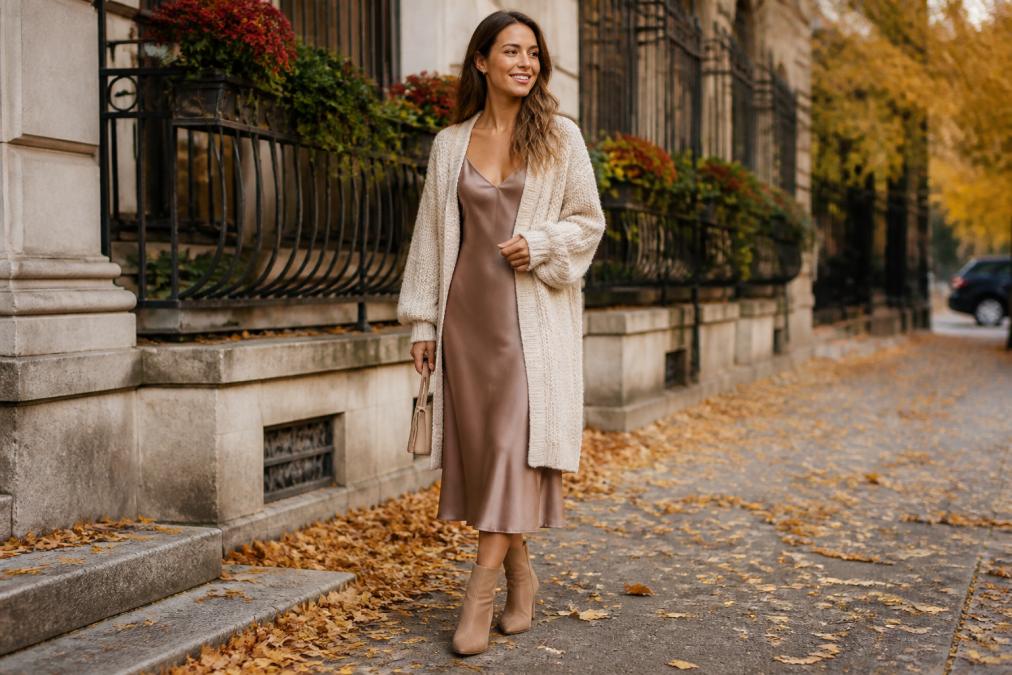
Layering makes a slip dress a year-round piece. The goal is contrast: the dress is fluid and light, so the layer above it should be structured or textured. Match layer weight to outside temperature, not the calendar, a 60°F afternoon and a 45°F evening call for two different layers over the same dress.
| Outside temp | Layer weight | Example layer | Why it works |
|---|---|---|---|
| 65-75°F | Featherweight | Sheer button-down, open linen shirt | Adds coverage without heat |
| 55-65°F | Lightweight | Cotton or fine-knit cardigan | Warmth without bulk |
| 45-55°F | Midweight | Wool-blend blazer, vegan leather moto | Structure plus insulation |
| 35-45°F | Heavyweight | Longline wool coat, teddy coat | Full coverage, dress becomes base layer |
Three layering approaches work consistently:
- The cardigan layer. An open-front cardigan adds warmth without hiding the silhouette; an oversized knit in a contrasting texture works best. Choose one hitting at or below the hip, a cropped cardigan cuts a midi slip dress's vertical line in half.
- The blazer layer. A structured blazer turns a slip dress into something close to office-appropriate. A single-breasted blazer with a defined shoulder beats a double-breasted one, whose extra fabric competes with the fluid drape underneath. If the blazer is oversized, keep the dress fitted; if the dress is loose, keep the blazer tailored.
- The jacket layer. A moto or biker jacket adds edge and works especially well for evening. Leather and vegan leather give the strongest contrast against satin: one texture is matte and stiff, the other glossy and fluid.
Proportion Rules That Keep Layering From Swallowing You
The most common layering failure isn't the wrong piece, it's the wrong proportion. Three rules fix most of it:

- One voluminous piece per outfit. If the cardigan is oversized, keep the dress fitted and the shoes sleek. Two oversized pieces read as shapeless.
- Keep the layer open. A buttoned cardigan or blazer hides the slip dress entirely. Open layers create two vertical lines that lengthen the silhouette.
- Match the layer length to the dress length. A layer ending within two inches of the dress hem looks intentional; one ending several inches above creates an awkward horizontal break.
Cold-Weather Add-Ons That Don't Ruin the Line
For cooler weather, add tights underneath and swap the flats for boots. The dress doesn't change. The layers do.
- Tights: Choose opaque black or a sheer 20-40 denier in a tone close to the dress. Contrasting sheer tights break the vertical line; matching opaque tights extend it.
- Boots: Knee-high boots over tights work with midi and maxi lengths; ankle boots suit shorter hems. A pointed toe keeps the line clean; a rounded toe reads casual.
- Scarves and belts: A belt over an open cardigan defines the waist without interrupting the dress. A long scarf worn open adds a vertical line, not a horizontal one.
Day to Night Fashion Transitions: A Step-by-Step Formula
Day to night fashion transitions work best as a two-step swap rather than a full outfit change: keep the dress and base layer, then change the pieces carrying the most visual weight. Here's the formula, in order.
Step 1: Start With a Neutral Base
Begin with a neutral slip dress and minimal jewelry. A neutral base lets the same dress read casual in daylight and elevated after dark, black, champagne, slate, and cream all work. A print or strong texture makes the transition harder: a print that reads playful at brunch reads busy at dinner, while a solid neutral reads intentional in both. Start with minimal jewelry, small studs or a single thin chain, so the statement piece you add in Step 2 feels like a change.
Step 2: Swap Accessories and Add Layers
Now make the two changes that do all the work:
- Remove the daytime layer. Take off the cardigan or denim jacket.
- Add the evening layer. Put on a structured jacket or blazer.
- Swap the shoes. Sneakers or flats out, heels or mules in.
- Change the bag. Tote out, small structured bag in.
The Transition Kit: What to Actually Pack
Going straight from a daytime setting to an evening one needs a small kit that fits in the daytime bag. Pack these five items:
- The evening layer, folded or rolled. A vegan leather blazer or structured jacket packs flat enough for a tote.
- The evening shoes, in a dust bag. Strappy heels or pointed mules take up less space than they look like they will.
- The evening bag, nested inside the daytime tote. A small structured bag fits inside most totes without adding bulk.
- A touch-up kit: blotting papers, lip color, and a small brush or comb. Daytime makeup and hair read differently under evening lighting.
- A garment steamer or wrinkle-release spray if the dress is satin. Satin creases visibly, and a dress crisp at 9 a.m. can look tired by 6 p.m.
The 10-Minute Transition Sequence
Order matters. Do the swaps in this sequence and the transition takes about ten minutes in a restroom or car:

- Change shoes first. This swap changes how the outfit reads most, and it's easiest to do standing.
- Remove the daytime layer and put on the evening layer. If the dress is satin, smooth it down after removing the cardigan, the fabric holds the shape of whatever was over it.
- Swap the bag. Move essentials (phone, card, keys, lip color) to the small bag, then stow the tote in the car or a coat check.
- Add the statement jewelry. This is the piece you held back in Step 1.
- Touch up hair and makeup last, after the clothing is settled, so nothing smudges during the change.
Common Transition Problems and Fixes
- The dress wrinkles in the bag. Satin and silk crease. If you're packing the dress, roll it instead of folding, and hang it in a steamy bathroom for five minutes before wearing.
- The evening layer is too warm for the venue. Vegan leather and wool blazers trap heat. If the venue runs warm, choose a lighter-fabric structured blazer, or plan to carry the layer.
- The daytime shoes don't fit in the bag. Wear the bulkier daytime shoes and pack the smaller evening shoes. Strappy heels fold flatter than sneakers.
- The transition happens in a car. Do the shoe swap last if you're driving, and keep the evening layer on a hanger in the back seat rather than folded.
Body-Type Styling Tips for Slip Dresses
Most styling guides skip this, and it's the gap that causes the most returns. A slip dress is unforgiving in specific ways, so knowing which version suits your frame saves trial and error.
- If you're petite: Choose a midi that hits above the ankle, not below it, to keep the vertical line intact. Pair with a heel or pointed flat.
- If you're tall: Maxi lengths work well and give you more fabric to work with. Bias-cut styles drape better on longer frames.
- If you have a fuller bust: Look for adjustable straps and a slightly higher neckline. A V-neck with a defined seam supports more than a straight-cut bodice.
- If you have a straighter frame: A bias-cut dress creates curve through the drape itself. Add a waist belt for more definition.
- If you carry weight in the midsection: Choose a slightly looser cut and layer with an open cardigan worn straight down for two vertical lines.
Undergarment Solutions for a Smooth Silhouette
The right undergarments matter more with a slip dress than almost any other piece, because the fabric shows everything underneath.
- Seamless underwear in a tone matching your skin, not the dress. Nude tones disappear under light fabric; white does not.
- A smooth, wire-free bra or bralette for coverage without visible structure.
- Shapewear shorts for a cleaner line under a bias-cut dress. Choose high-waisted so it doesn't create a band across the middle.
- A slip or half-slip under lighter satin, to stop the dress clinging.
Capsule Wardrobe Integration: Making Your Slip Dress a Staple
A slip dress earns a permanent place in a capsule wardrobe because it works across more occasions than almost anything else. One dress covers brunch, office, dinner, and evening events with only a layer and shoe change.
- One neutral slip dress
- One structured layer (blazer or jacket)
- One soft layer (cardigan)
- One flat shoe, one heel
- One small evening bag
Sustainable Care and Maintenance for Longevity
Satin and silk slip dresses last longer when treated gently. The fabric is the investment, and how you wash it decides whether the dress survives more than a season.
- Wash cold, on delicate, or by hand. Heat breaks down satin fibers over time.
- Use a mesh laundry bag when machine washing, to prevent snags from zippers and hooks.
- Skip the dryer. Hang to dry flat or on a padded hanger. Tumble drying damages the sheen.
- Store on a padded hanger, not folded, to avoid crease lines that don't press out.
- Treat stains immediately with cold water before they set.
Frequently Asked Questions
Are slip dresses still in style in 2026?
Yes, slip dresses remain a wardrobe staple in 2026. Their minimalist, versatile design makes them a key piece for day-to-night styling. Fashion trends 2026 show them in satin finishes, midi lengths, and neutral tones. They work across seasons when layered with oversized knit cardigans or trench coats. For a modern take, pair with pointed-toe mules or strappy heels.
How do you transition a slip dress from day to night?
Start with a relaxed daytime look: wear your slip dress with a t-shirt underneath, sneakers, and a crossbody bag. For evening, swap the t-shirt for a vegan leather blazer, change into strappy heels, and add statement jewelry. This day to night fashion transition takes minutes and works with any slip dress. Keep accessories minimal during the day and bold at night.
What shoes go best with a slip dress for a casual look?
For a casual look, choose white sneakers, flat sandals, or ballet flats. These shoes to wear with a slip dress keep the outfit relaxed and comfortable. Avoid heels during the day unless you're aiming for a dressier vibe. A pair of clean white sneakers contrasts nicely with the delicate fabric. For a bit of height, try platform sandals or mules.
What layers work best over a slip dress for cooler weather?
When learning how to layer a slip dress for fall, reach for an oversized knit cardigan, a trench coat, or a vegan leather jacket. These layers add warmth without hiding the dress's silhouette. A cropped jacket defines the waist, while a long cardigan creates a relaxed feel. Add tights and ankle boots for extra insulation. Texture mixing, like satin with chunky knits, elevates the look.
Building a wardrobe that works for both daytime and evening usually means buying twice as much. It doesn't have to. Jessiz Boutique curates pieces designed to layer and transition, with a focus on quality and style at prices that don't force a compromise. Explore the collection, find a neutral slip dress and a structured layer, and let two swaps do the rest. Shop now and build the outfit that works from morning to midnight.